
Updated: 13 September 2026
If you want to finish in the middle of the pack, copy the most popular team and hope for the best.
If you want to actually gain ground in NBL27 SuperCoach, you need at least a little courage.
That does not mean picking random names nobody else wants. A proper POD is not just low-owned. It still needs a real role, a believable scoring path and a schedule or price point that can justify the selection.
That is the line we are trying to walk here.
The obvious Round 1 names are obvious for a reason. Sam Mennenga makes sense. Hunter Goodrick makes sense. Arnas Velička makes sense. We are not fading good players just to be different.
But if your whole team is built from the same popular pool as everybody else, you leave yourself no way to move early unless chaos breaks perfectly in your favour.
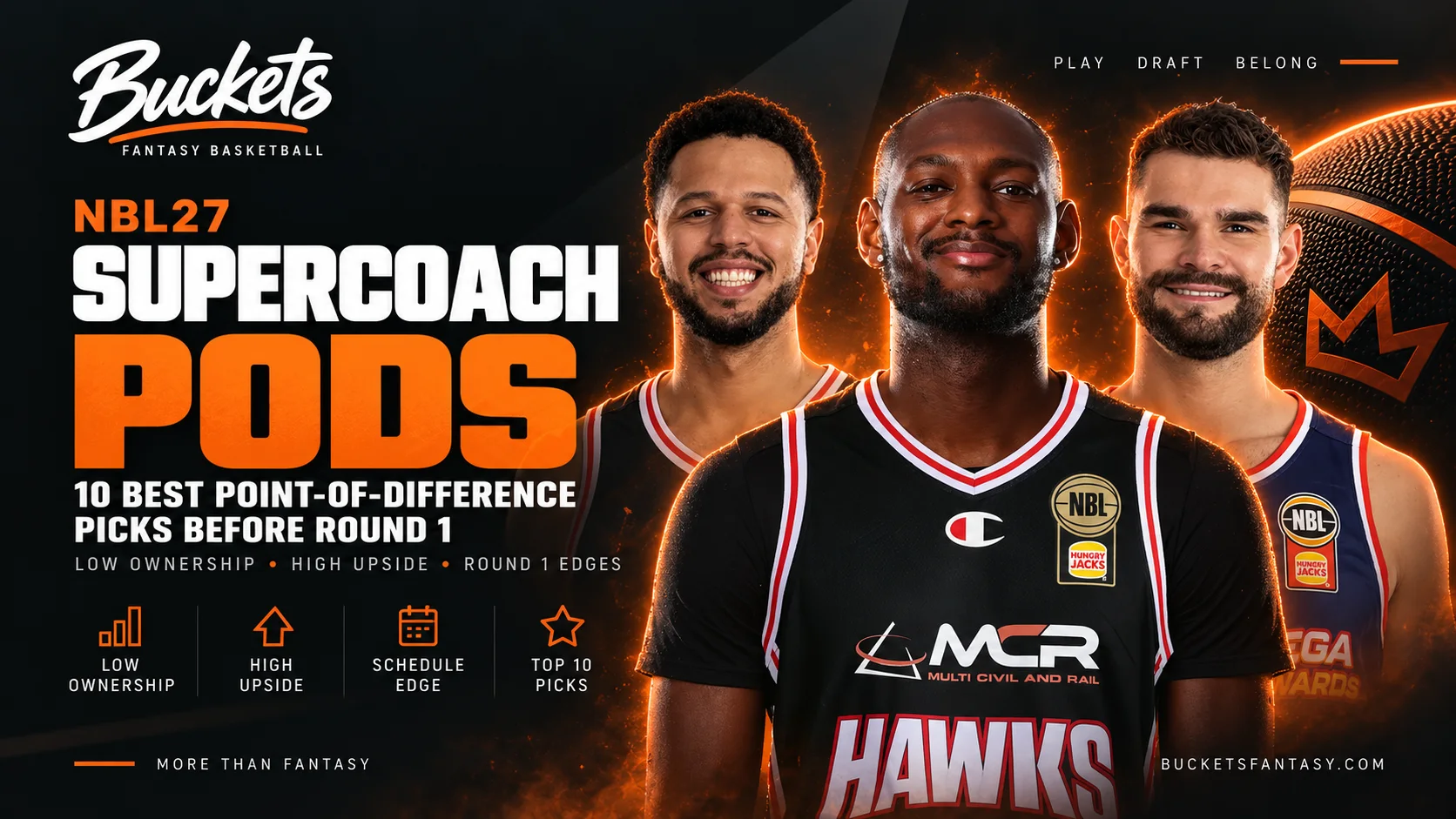
So this is the Buckets POD board: 10 NBL27 SuperCoach point-of-difference picks who give you a genuine edge before Round 1 without asking you to light your team on fire.
Before we get into the names, make sure you have also read our NBL27 SuperCoach Round 1 Injury Report, Best Starting Team, Cheapies Guide and Fixture Guide. A POD is only a good pick if the structure around it still works.
The Buckets POD board
| Player | Team | Position | Ownership | POD type | Buckets call |
|---|---|---|---|---|---|
| Milton Doyle | Illawarra | GRD | 1.4% | Mid-price POD | Strong buy |
| Tyler Harvey | Illawarra | GRD | 1.1% | Premium-ish POD | Aggressive buy |
| Isaac Humphries | Adelaide | CTR | 2.6% | Premium POD | Startable |
| Nick Rakocevic | Adelaide | FWD | 5.8% | Value POD | Strong buy |
| Charles Bediako | New Zealand | CTR | 4.1% | Schedule POD | Strong watch |
| D'Shawn Schwartz | South East Melbourne | FWD | 3.1% | Double-round POD | Viable |
| Elijah Pepper | Perth | GRD | 3.2% | Boom-bust POD | Aggressive watch |
| Reyne Smith | Cairns | GRD | 3.7% | Fixture POD | Watchlist |
| Max Mackinnon | Brisbane | GRD/FWD | 4.5% | Breakout POD | Bench stab |
| Matthew Dellavedova | Sydney | GRD | 0.8% | Veteran POD | Patience play |
What counts as a good POD in NBL27 SuperCoach?
A good POD usually ticks at least three boxes:
- Low ownership
- A role that can actually produce points
- A plausible way to beat the popular alternative
- A schedule or price edge
- A reason the field might be underestimating them
That last part matters.
Sometimes the market is wrong because it is lazy. Sometimes it is wrong because it is overreacting to one preseason game. Sometimes it is wrong because everybody is trying to jam the same stars and cheapies into one build.
That is where PODs live.
1. Milton Doyle, Illawarra Hawks
Milton Doyle is one of the clearest examples of a player who should be attracting more attention than he is.
When the official middle-band ownership snapshot was published, Doyle was sitting at just 1.4 per cent ownership despite averaging 26.48 SuperCoach points across all 33 games last season. He then backed that up at the Blitz with a 35.5 average, one of the best marks in the whole tournament.
This is the exact kind of player we want in a POD article.
He is not a speculative rookie. He is not a dead-price cheapie. He is not somebody who needs three injuries ahead of him to matter. He is already a proven fantasy scorer, and Illawarra’s schedule becomes very attractive immediately after Round 1.
The risk is obvious enough: the Hawks are loaded. Tyler Harvey is still there. William Hickey is still there. Usage has to be shared.
But Doyle does not need to be the only creator to win. He can score, assist and generate steals, and he has already shown he can survive in fantasy alongside other good guards.
Buckets call: one of the best real PODs in the game. If you want to be different without being stupid, start here.
2. Tyler Harvey, Illawarra Hawks
If Doyle is the sensible POD, Tyler Harvey is the more aggressive version.
The official ownership snapshot had Harvey at just 1.1 per cent, which is absurdly low for a player who averaged 26.19 SuperCoach points last season and still owns one of the best shot-making profiles in the league.
Why is he a POD? Because the field is nervous about role compression.
That fear is understandable. Illawarra has more playmakers now, and Harvey is more scoring-dependent than Hickey or Doyle. But the flip side is that Harvey’s life may actually become easier if the ball-handling burden is shared better. He does not need to create everything himself to go off.
And when Harvey goes off, he can swing a round quickly.
This is not the safe route. He will have volatility. But that is also how you separate.
Buckets call: a true upside POD. Better for coaches who want to attack rather than merely keep pace.
3. Isaac Humphries, Adelaide 36ers
Everybody loves Bryce Cotton. Everybody understands Adelaide’s early draw. But one of the more interesting contrarian ways into that team is Isaac Humphries.
In the public ownership piece, Humphries was at just 2.6 per cent ownership despite averaging 25.58 SuperCoach points across 33 games last season.
Centre is always awkward in SuperCoach. That matters here.
Most coaches either spend heavily on the obvious names or try to survive with structure picks and cheap dual-position flexibility. Humphries sits in the uncomfortable middle, which is exactly why he becomes interesting.
He can block shots, rebound, score efficiently and threaten double-doubles. Adelaide’s early schedule run also gives him a genuine chance to beat his opening slot if the minutes are strong.
The downside is role competition. Nick Rakocevic is there. Adelaide has multiple frontcourt options. You are buying upside with some rotation risk attached.
Buckets call: one of the most interesting premium-ish POD centres if you do not want to copy the field.
4. Nick Rakocevic, Adelaide 36ers
This is more our speed.
Rakocevic was sitting at 5.8 per cent ownership in the official middle-band snapshot and shapes as one of the cleaner value PODs on the board.
He is not flashy, which is often exactly what you want.
Rakocevic rebounds. He can clean up around the basket. He has enough size to stay useful even when the scoring is modest. And in SuperCoach, boring rebounds still count exactly the same as exciting ones.
What we like most is that the case does not require fantasy gymnastics. Adelaide has a strong early schedule run, and Rakocevic’s role looks far more stable than his ownership suggests.
He is also the kind of player who fits a real Round 1 structure. You are not forcing him in to be clever. You are taking a solid player that the field seems happy to ignore.
Buckets call: one of the best value PODs before lockout.
5. Charles Bediako, New Zealand Breakers
Charles Bediako is one of the most interesting centre calls in the whole player pool.
He does not have the same public ownership angle as some of the names above, but the fantasy logic is obvious. He is a genuine centre on a Round 1 double, and centre scarcity always matters more than coaches want to admit.
If you are reading this after our Round 1 Team Reveal, you already know the central tension: structure is pushing a lot of teams into cheap centre solutions.
Bediako gives you a different path.
He has size, rebounding potential and block upside. If he wins a meaningful enough share of the minutes, the two-game opening round gives him a head start over plenty of more popular one-game options.
There is still risk. Sam Mennenga will soak up frontcourt production, and New Zealand has a few moving parts around the big rotation.
But if you want a POD with a proper schedule case, Bediako absolutely belongs in the conversation.
Buckets call: high-upside centre POD, especially for coaches unhappy with the chalk cheap-centre route.
6. D'Shawn Schwartz, South East Melbourne Phoenix
A lot of the Phoenix conversation has gone where you would expect: Nathan Sobey, Skylar Mays, Dash Daniels, Hunter Goodrick.
That leaves D'Shawn Schwartz living in a quieter part of the market.
We actually like that.
South East Melbourne is one of only two clubs on the Round 1 double, and Schwartz has already produced usable preseason lines without needing to dominate the ball. In the official preseason tracker he posted 25 SuperCoach points against Cairns, and he has looked like a meaningful rotation piece rather than an afterthought.
The appeal here is simple. He is not priced or owned like the main stars, but he can still benefit from the same two-game start.
That is often all you want from a POD. Not a miracle. Just a player who can quietly outscore the more obvious alternatives.
Buckets call: viable double-round POD if you want another Phoenix angle without paying Sobey or forcing Goodrick.
7. Elijah Pepper, Perth Wildcats
Elijah Pepper is the classic boom-bust POD.
The official middle-band article had him at 3.2 per cent ownership, and the Blitz reminded everybody why he is dangerous, with 40 SuperCoach points in Perth’s opening tournament game according to the official score tracker.
The case is obvious. He shoots. A lot. And SuperCoach does not punish missed field goals.
That scoring system matters for Pepper more than for many other players. A volume shooter with a green light can become fantasy relevant very quickly, even if the all-round game is still developing.
The concern, obviously, is stability. Perth’s backcourt picture has had moving parts through preseason, and you are buying some volatility with the upside.
That makes him a POD by nature. He is not a plug-and-play safety pick. He is a bet that shot volume and opportunity matter more than caution.
Buckets call: aggressive coaches only, but the ceiling is real.
8. Reyne Smith, Cairns Taipans
Reyne Smith is another player whose fantasy profile fits the scoring system beautifully.
In the official preseason tracker he produced 31 SuperCoach points against Perth and followed with 29 against South East Melbourne. That is enough to matter, particularly when Cairns’ early schedule quickly becomes attractive after Round 1.
The field tends to be sceptical of players who lean on shooting.
Sometimes that scepticism is fair. But in this game, threes count, hot streaks count, and misses are not punished. That gives scoring wings and guards more fantasy life than they might have in other formats.
Smith is also helped by role context. Cairns has clear usage leaders, but there is room for him to be a real scoring piece, not just a spacer standing in the corner.
He is not as secure as Jack McVeigh or Keanu Pinder. That is why he is a POD instead of a mainstream pick.
Buckets call: not a must-start, but one of the more interesting under-owned Cairns routes if you are planning ahead.
9. Max Mackinnon, Brisbane Bullets
This is the fun one.
Max Mackinnon is not in this article because he is already polished. He is here because if the role grows, the upside becomes very hard to ignore.
Brisbane’s roster is still one of the more fluid ones in the competition, and that makes Mackinnon an appealing bench POD. The field is understandably gravitating harder toward Arnas Velička, Nate Hinton and Tyrell Harrison. Fair enough.
But PODs often emerge from the space behind the obvious trio.
Mackinnon has shown enough scoring intent to stay interesting, and the key here is not asking him to carry your team. You are asking whether he can outperform a bench slot and become a tradeable asset before the crowd reacts.
This is not a safe starting pick. It is a calculated stab.
Buckets call: bench POD only, but exactly the sort of swing that can pay off early.
10. Matthew Dellavedova, Sydney Kings
Matthew Dellavedova was sitting at just 0.8 per cent ownership in the official public snapshot, which immediately makes him worth discussing.
The first thing to say is this: Dellavedova is not a Round 1 must-have.
Sydney only has one game to start, and there are cleaner Round 1 structures elsewhere.
But the reason he still makes this list is that PODs are not only about the first opening score. They are also about being early on players the market is happy to dismiss.
Dellavedova still brings assist potential, control, competitiveness and the sort of veteran stability that can matter once Sydney’s schedule improves. If you are building a team with a little patience and you do not want to follow the exact same premium-guard template as everybody else, Delly is a legitimate route.
He is not the flashy option. He is the grown-up option.
Buckets call: patience POD rather than immediate smash play, but the ownership is low enough that he deserves a mention.
The three best PODs if you only want a shortlist
If you do not want to read the whole thing and just want the Buckets shortlist, here it is:
1. Milton Doyle
The cleanest blend of role, scoring record, low ownership and early upside.
2. Nick Rakocevic
A genuinely useful player with a friendly price and far less attention than he deserves.
3. Charles Bediako
A centre POD with a Round 1 double is always worth serious thought.
How many PODs should you actually start with?
Probably fewer than you think.
There is a temptation to turn an entire team into a contrarian statement. That is usually how bad teams happen.
Our general rule:
- 1 POD if you want a safer build
- 2 PODs if you want to create real separation
- 3 PODs only if the rest of your structure is very solid
Once you move beyond that, you stop being clever and start getting cute.
There is no prize for having the weirdest team in Round 1.
The Buckets take
A good POD is not a random dart. It is a player the field is overlooking for the wrong reason.
That is why we like this list.
Milton Doyle and Tyler Harvey give you proven production the market seems to be ignoring. Rakocevic and Humphries give you Adelaide exposure without just copying the same builds. Bediako and Schwartz create real Round 1 alternative paths. Pepper, Reyne Smith and Mackinnon offer more aggressive upside. Dellavedova is the veteran patience play if you are willing to think a step ahead.
Will all 10 hit? Of course not.
That is not the point.
The point is to find one or two under-owned players who can beat the popular alternative and give your squad a shape the rest of the field cannot easily copy.
That is how PODs are supposed to work.
NBL27 SuperCoach PODs FAQ
What is a POD in SuperCoach?
POD stands for point of difference. It usually means a player with relatively low ownership who can help your team gain ground on the field if they score well.
How many PODs should I pick for Round 1?
Usually one or two is enough. Three is fine if the rest of your team is stable. More than that and you are probably forcing it.
Should a POD always be low-owned?
Yes, but low ownership alone is not enough. A proper POD also needs role, scoring pathways and some kind of structural case.
Are single-game players still worth picking as PODs?
Yes, if the player is good enough and the early schedule or price path is strong enough. You do not need every POD to come from a Round 1 double team.
Who is the best premium POD before Round 1?
From this list, Isaac Humphries is the best premium-style POD. If you want a higher-upside guard swing, Tyler Harvey is the aggressive alternative.
Who is the best value POD before Round 1?
Nick Rakocevic is the cleanest value POD. Milton Doyle is probably the strongest all-round POD regardless of category.
What to read next
- NBL27 SuperCoach Round 1 Injury Report: Selection Watch Before Lockout
- NBL27 SuperCoach Best Starting Team: Our Round 1 Team Reveal
- NBL27 SuperCoach Premiums: Who Is Actually Worth Paying Up For?
- NBL27 SuperCoach Cheapies: Best Cash Cows, Bargains & Cap Savers
- NBL27 SuperCoach Fixture Guide: Double-Game Rounds & Best Early Schedules
- NBL27 SuperCoach Final Preseason Stock Report: Risers, Fallers & Round 1 Calls
Sources and methodology
This POD guide uses official SuperCoach NBL launch coverage, official ownership references published in preseason coverage, the official Blitz and preseason SuperCoach score trackers, and the official NBL27 double-game guide. We prefer PODs with a real role, scoring path and structural reason to beat the field, rather than players who are merely obscure.
Key references:
- Stuck in the middle: SuperCoach NBL Classic
- Blitz player-by-player scores: SuperCoach NBL Classic
- Pre-season player-by-player scores: SuperCoach NBL Classic
- Your guide to double-game rounds: SuperCoach NBL Classic
- Your ultimate explainer: SuperCoach NBL Classic
Buckets is an independent fantasy basketball platform and is not affiliated with SuperCoach or the National Basketball League. SuperCoach is referenced for analysis and scoring comparison.
Comments